
American Pride Flagpoles vs Competitors: Which Fits Your Home?
Last Updated: November 2, 2026
Quick Summary
American pride flagpoles are best compared on documentation, not marketing claims: ask every seller for wall thickness, wind rating test method, split warranty terms, and replacement parts availability. Telescoping poles suit rentals and seasonal displays, while sectional aluminum poles are the more durable choice for permanent front-yard installations.
In-ground residential poles are usually 15 to 25 feet, with a 3 ft by 5 ft flag for 15- or 20-foot poles.
Telescoping poles win on portability, but sectional aluminum holds up better in sustained wind.
Flagpole installation cost is driven by pole height, footing requirements, site access, and electrical work.
Compare structural, finish, and fabric warranties as three separate documents before buying.
Call 811 before digging so your footing does not intersect a buried utility line.
Table of Contents
American Pride Flagpoles vs Competitors: What the Field Actually Offers
Best Residential Flagpoles: Matching Pole Type to Your Property
Telescoping Flagpoles vs Sectional Flagpoles: Which Design Wins
Flagpole Installation Cost: What Drives the Price Up or Down
Durability, Wind Ratings, and Warranty: Where Claims Meet Evidence
Comparing American Pride Flagpoles with North American Flags
Choosing Your Flagpole: Next Steps with North American Flags
American Pride Flagpoles vs Competitors: What the Field Actually Offers
American pride flagpoles sit at the center of a crowded market, and the comparison is harder than most buying guides admit. Households differ enormously in what they want from a pole, so a single "best flagpole" answer serves almost no one. Buyers often get talked into the wrong product far more often than the wrong brand.
Below, we break down pole types, sizing, installation costs, and durability claims so you can match a product to your property instead of a marketing page. Longevity and wind claims are easy to make and hard to verify, and almost no seller publishes side-by-side test data.
Best Residential Flagpoles: Matching Pole Type to Your Property
Best residential flagpoles depend on three variables: yard space, wind exposure, and how much maintenance you will tolerate. A 20-foot in-ground aluminum pole suits a suburban front yard with clear setbacks; a wall-mounted kit fits a townhouse with no lawn. Neither is "better" in the abstract.
Three formats dominate the residential market:
In-ground sectional poles in aluminum, tapered for stiffness, set in a ground sleeve and concrete
Telescoping flagpole kits, which collapse for storage and adjust height without digging
Wall-mounted and outrigger poles, typically 5 to 6 feet, for porches and entryways
What most guides miss is that the pole is a system. Halyard, cleat, pulley, finial, and flag clips all wear out, and replacement parts availability matters more five years in than any spec sheet does on day one.
Telescoping Flagpoles vs Sectional Flagpoles: Which Design Wins
Telescoping flagpoles win on portability and setup ease; sectional flagpoles win on rigidity and height. Telescoping designs use nested tubes that extend and lock, so one person can raise a 20-foot pole without concrete. Sectional poles assemble from fixed-length sections and, once set in a ground sleeve, hold up better in sustained wind and reach heights telescoping poles cannot.
For a rental property, a seasonal display, or a pole you want to move, telescoping makes sense.
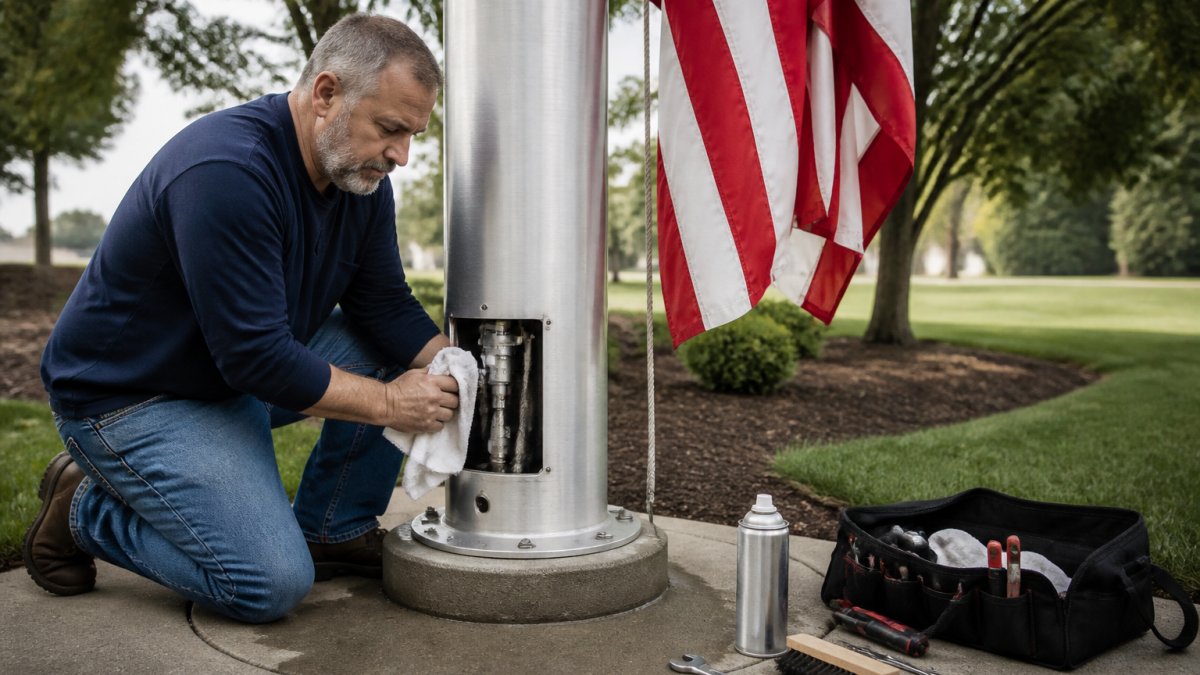
For a permanent front-yard installation, sectional aluminum is the more durable answer. Watch out: telescoping poles that bind or seize after a season of grit and weather are a common complaint, and cleaning the tubes is the maintenance step owners skip.
Flagpole Height for a House: Sizing the Pole and the Flag
The right flagpole height for a house is usually 15 to 25 feet for an in-ground residential pole, with the flag sized to the pole rather than the other way around.

Get this ratio wrong and the flag can whip, wrap, and wear out early. An oversized flag on a light pole also loads the halyard and cleat beyond what they were built for. Our guidance on choosing the right flag size for your flagpole walks through the dimensions against common pole heights.
Height also has a practical ceiling.
Flagpole Installation Cost: What Drives the Price Up or Down
Flagpole installation cost is driven by four things: pole height, footing requirements, site access, and whether lighting or electrical work is involved.
Cost Driver | What Raises the Price | What Keeps It Down |
Pole height | Taller poles need heavier footings and equipment | 15-20 ft residential poles |
Soil and site | Rock, slope, buried utilities | Level, clear, diggable ground |
Mounting type | In-ground concrete foundation | Wall-mounted or outrigger kits |
Add-ons | Lighting, electrical runs, multiple poles | Flag and hardware only |
We do not publish a single flat rate because the variables are too wide, and any guide quoting one number for every yard is guessing. Our flagpole installation services page lays out residential and commercial setups.
Durability, Wind Ratings, and Warranty: Where Claims Meet Evidence
Durability is the hardest thing to compare in this market because the numbers that matter are rarely printed on the same page.
Stop comparing adjectives and start comparing the five specifications that actually predict how long a pole and flag survive:
Pole alloy and wall thickness. Aluminum resists corrosion, but two poles of the same height can differ substantially in wall thickness. A thicker wall resists bending fatigue at the base and at the halyard exit point. Ask for the wall thickness in inches, not a "heavy-duty" label.
Taper versus straight section. A tapered pole adds stiffness at the base without adding weight at the top, which is why most permanent residential and commercial poles are tapered. Straight sectional poles are common in budget kits and flex more under sustained load.
Finish system. Anodized and powder-coated finishes resist chalk and corrosion differently. A finish warranty is only meaningful if it is written separately from the structural warranty and states what voids it.
Fabric and stitching. Denier, dye method, and stitch type (chain stitch versus lock stitch at the fly end) separate a two-season flag from a multi-season flag.
Wind rating and what it means. A published wind rating should state whether it is a sustained-wind or gust figure, whether the flag was flying during the test, and whether the rating applies to the pole, the flag, or both. A pole rated for high sustained wind with no flag attached tells you little about a flag display in a storm.
A wind rating without a test method is a marketing number. Ask the seller whether the rating is based on an engineered calculation, a third-party test, or an internal estimate, and get the answer in writing before you buy.
Warranty terms deserve the same scrutiny. Compare the structural warranty (the pole), the finish warranty (coating and anodizing), and the fabric warranty (the flag) as three separate documents.
Replacement parts are the ownership factor almost no buying guide prices out. Halyards, cleats, pulleys, flag clips, and finials fail first, and a pole with proprietary or discontinued hardware can become a maintenance problem five years in.
Finally, treat independent verification as a buying criterion. A supplier in the flagpole market, per LeadIQ's flagpole market analysis, identifies sustainable materials, durable finishes, and end-of-life recycling as differentiators, though the source reports no adoption rates.
Comparing American Pride Flagpoles with North American Flags
Comparing American Pride Flagpoles with a full-service supplier comes down to what you are buying: a product, or a product plus installation and support.
The side-by-side framework most guides skip
Instead of a table of marketing claims, use a specification sheet you fill in for each candidate. Ask every seller, American Pride Flagpoles, North American Flags, or anyone else, for the same eight data points, and compare them in one place:
Pole material and wall thickness (alloy and thickness in inches)
Height options and whether the pole is tapered or straight
Wind rating, with the test method and whether a flag was flying
Warranty terms, split into structural, finish, and fabric
Included hardware, halyard, cleat, pulley, finial, flag clips, ground sleeve
Replacement parts availability for the model you are buying
Installation requirements, footing size, soil assumptions, mounting surface
Delivered price, including shipping and any accessories needed to fly a flag
A seller that will not supply these in writing is telling you something useful. The comparison is only as good as the documentation behind it.
Total cost of ownership, not sticker price
Purchase price is the smallest part of what a flagpole costs over its life. The ownership costs that separate a good decision from a regretted one are:
Shipping. Long poles ship by freight, and freight is often quoted separately. Telescoping kits that ship by parcel can look cheaper until you compare a delivered sectional pole.
Installation. An in-ground pole needs a footing, a ground sleeve, and concrete. A wall-mounted or outrigger kit avoids digging but requires suitable mounting structure. Professional installation adds labor and, for taller poles, equipment.
Accessories. A flag, a light, and a mounting bracket are frequently sold separately. Price the complete display, not the pole alone.
Maintenance. Halyard replacement, cleat tightening, and periodic cleaning are recurring costs. A pole that seizes or binds adds labor.
Replacement. Flags wear out faster than poles. A flag that lasts several seasons instead of one changes the multi-year cost more than a small difference in pole price.
Installation requirements and site suitability
This is where the two approaches diverge most in practice. A manufacturer selling a pole ships you a product and a set of instructions; a full-service supplier evaluates the site first. The questions that determine whether a pole is suitable for your property are concrete:
Soil and drainage. Diggable, well-drained soil is the easy case. Rock, clay, high water tables, and slope change the footing design.
Buried utilities. Call 811 before any digging (811 Before You Dig). A footing that intersects a utility line is a costly mistake.
Exposure. A pole on an open, windy lot needs a heavier footing and a pole rated for the load than one sheltered by trees or buildings.
Mounting surface. Wall-mounted and outrigger poles require sound framing or masonry. A porch column is not always rated for the lever arm of a flag in wind.
Height and access. Above roughly 25 feet, residential poles generally need engineered footings, and service access often means a tilt-down base.
How the two approaches differ in practice
American Pride Flagpoles
North American Flags
Family-owned, operating since 1972, with all products made in the USA
Turnkey installation and maintenance, plus custom logo flags and banners
Ground-mounted poles up to 150 ft, house-mounted kits, and lighting
The broader cultural context matters too. A Florida State University Institute for Governance and Civics report combining 23 survey series from 1981 to 2026 found national attachment shifting over four decades, and Gallup recorded its lowest pride reading in a 25-year trend in 2026. Buyers are more deliberate about displays than they were a generation ago, which rewards suppliers who answer questions plainly and document what they sell.
Choosing Your Flagpole: Next Steps with North American Flags
The decision comes down to permanence and support. If you want a permanent residential display and would rather not manage a footing, a halyard, and a warranty claim on your own, work with a supplier who installs what it sells. We handle residential setups, commercial foundations, and lighting. Review our full flagpole services menu to see what fits your property.
Get started with North American Flags and put a pole in the ground that you will not have to think about again.
Frequently Asked Questions
How do American Pride Flagpoles compare with other flagpole brands?
American Pride Flagpoles is a domestic manufacturer, but the available research does not include comparative test data, prices, or market share for its products against named competitors. When comparing any brand, ask for written specifications, warranty terms, and replacement-part availability rather than relying on marketing claims alone.
Are telescoping flagpoles better than sectional flagpoles?
Telescoping flagpoles collapse into nested sections and are quicker to raise and lower, which suits homeowners who want easy setup. Sectional flagpoles use fixed, bolted sections and tend to be sturdier in high-wind locations. Neither is universally better: choose telescoping for convenience and sectional for maximum wind resistance and commercial durability. North American Flags offers both types so you can match the design to your site.
What size flagpole is best for a house?
Most homes look right with a 15- to 25-foot in-ground flagpole, paired with a 3 ft by 5 ft flag. AmericanFlags.com's residential guide recommends a 3 ft by 5 ft flag for 15- or 20-foot poles and a 2.5 ft by 4 ft flag for 5-foot poles. A taller pole needs a larger flag to stay proportional, but never exceed the manufacturer's wind rating for your area.
How much does a residential flagpole cost, including installation?
Pole prices vary by height, material, and design. Installation cost depends on soil conditions, pole height, and whether a ground sleeve is used.
Comments